

Unity. Light. Love.
Practice
Whirling


This is a very ancient practice, found in one form or another in many spiritual traditions. I recommend doing it every day. Begin with one minute at an easy pace and gradually work up to thirty minutes at a very fast pace. If you live in a house with an outdoor space or garden free of objects you might trip over or hit, these are ideal conditions. City dwellers obliged to practise indoors face more difficulty. Even so, I recommend doing at least three sessions outdoors first: discover your response to the practice and learn about yourself. Only then begin whirling indoors.
If you wish, add clothing that lifts as you turn and creates a sense of volume, such as a skirt. You can also use ordinary strips of fabric like scarves: knot one end to give it a little weight and attach the other to a waistband or fabric belt. The belt can simply be tied around your waist. Attach four strips, one in front, one behind and one on each side. Their knotted ends will lift as you turn. Choose their length and number as you wish.
Do not do this exercise after eating; allow at least three hours. Initially, however, you may still feel nauseous, especially when you sit to meditate immediately afterwards. Work through this, remembering to become accustomed to the state gradually.
This is a very powerful practice. I can say that ten minutes devoted to it are equivalent to a hundred years of your soul's ordinary evolution.
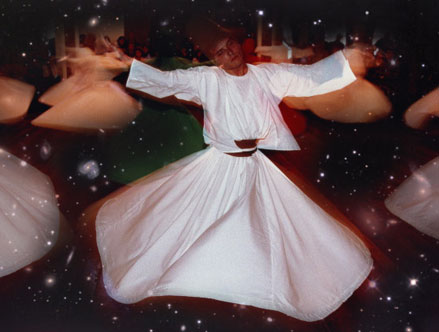
Let me again emphasise the precautions needed when whirling. Make sure there are no sharp corners nearby. If you lose your balance, do not try to stop while standing: sit down immediately. Do not attempt to regain your balance, as this creates a strong risk of falling.
Suggested music for this practice:
 download (2.51 MB — 2.5 minutes)
Set the track to repeat so that it plays continuously.
© Author: Sergey Veretennikov (Om Shanti)
(Practice given on 22 April 2004.)
How astonishingly time flies. Almost ten years have passed since I gave you this version of whirling. Time does not stand still; it moves on. Some may need to hurry to accomplish something in time, while others may need to consider whether they are standing still.
Over the years, practitioners have accumulated certain recurring questions. There are things to add, and further encouragement to offer those who hesitate or have even forgotten this practice since its publication.
First, I recently made a new video to inspire those following the path of self-development. Watch it.
Perhaps the most frequent question is which direction to turn and how the two directions differ. It is strange that this keeps being asked, since I answered it many times, beginning almost immediately after giving the practice.
I will answer again. Both directions work. One works with muladhara, the other with sahasrara. Muladhara is a mirror reflection of sahasrara. If sahasrara turns clockwise when viewed from above, muladhara turns anticlockwise from that same viewpoint above the head. Viewed from below, however, muladhara also turns clockwise. Personally, I consider work with sahasrara more important, so I gave clockwise whirling as the main version, while allowing anticlockwise turning too.
Both chakras matter. One works with Kundalini energy and ascending Shakti; the other, sahasrara, works with Shakti descending from spiritual reality. Both energies are spiritual. Ultimately, whether one rises or the other descends, the effect is the same: Enlightenment. They are two Paths to one Goal. The final result therefore does not depend on your direction of rotation. Nevertheless, I recommend clockwise whirling as the gentler, easier Path.
I also gave a brief description of this practice on social media, which you may find useful.
As I did almost ten years ago, I would again like to offer a piece of music that is pleasant to whirl to.
download (8 MB — 9 minutes)
The second point that causes difficulty is how to move the feet. Everyone does this differently, so naturally people ask which way is best or most correct.
One option is to make the right leg the axis of rotation. The left foot propels the body like a spinning top, whose point is the right foot. This works on a polished floor.
Personally, however, I do not find it the best option. It is better for the axis to pass through the spine. When this happens, you begin to feel something special occurring on the energetic level: the physical and energetic have aligned. The flow of rotation centres exactly where it should, without even a centimetre of imbalance. You become one with what is happening.
In this case the rotation has two components:
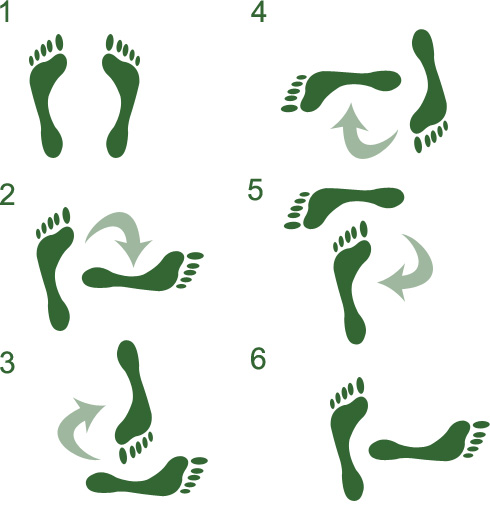
Another interesting question concerns turning the head as ballet dancers do. Do not do this. Simply watch objects passing before your eyes, while thinking of the Universe around you.
Some practitioners also ignore the half of my practice that begins immediately after whirling stops. This is not the end, but the beginning of a substantial second half. Do not think the practice is over. When you sit to meditate afterwards, something even more interesting begins. I did not explain exactly how to meditate in the original practice and will not do so now; I indicated only the essentials. Energy itself will guide you. Simply trust it.
© Author: Sergey Veretennikov (Om Shanti)
(Continuation of “Whirling” given on 26 September 2013.)


