

Unity. Light. Love.
Practice
Wait and Listen

 One day, a disciple and his Teacher were sitting in the mountains, meditating. The disciple had studied for a long time, and now the time had come for him to leave. He was to go among people and tell them about the Truth he had come to know through his Teacher.
“Teacher, could you express the meaning of all religions, teachings and philosophies in just a few words?” the disciple asked.
“Yes,” replied the Teacher. “Wait and listen.”
“What should I wait for, Teacher?”
“The answer,” said the Teacher.
“And is it the answer I should listen to?”
A smile merely passed over the Teacher's face, and boundless love for his disciple shone in his eyes. (Om Shanti)
Waiting and listening are things people in our world no longer know how to do. If they want something, they want it immediately. When they talk to one another, they want to be the only one listened to. If this does not happen, they start shouting; if that does not help, they may even begin fighting. This is people's chief affliction. They do not know how to wait; even waiting a little is painful. They cannot listen even to other people whom they can see, let alone hear beings from higher dimensions. And even if someone rises in purity and in the wish to hear, an inability to wait will deprive them of the nectar of hearing the answer.
In this practice, I want to teach you the essence of all spiritual activity and practice: the art of waiting and listening. In essence, all spiritual activity and practice come down to this. It is not special mantras, exercises, prayers or other activities that will ultimately crown your search, but the ability to wait and listen.
After mastering this practice, move on to the main exercise: waiting and listening in meditation. For example, you relax, stop your thoughts and ask a question that concerns you, such as “Am I living rightly?” You will then notice the processes of “waiting” and “listening” merging into one. They become a single activity: you wait and listen simultaneously.
You may ask any questions that matter to you, and you will certainly receive an answer. Naturally, the answer comes from the place from which you entered this world: the world of which you remain a part, even though a little part of it—the soul—is now enclosed in a shell of matter and illusion. You may call the one who answers God, the Higher Self, the Absolute, and so on. But I think any of these definitions will always be less than entirely accurate, so try not to think within such boundaries; learn to think beyond all boundaries.
© Author: Sergey Veretennikov (Om Shanti)
Practice given on 14 October 2011.
See also the meditation Waiting for the Meeting.
How to listen to your pulse:
You can actually use any method, including the familiar medical method of placing two or three fingers over the blood vessel, if you find that more comfortable:
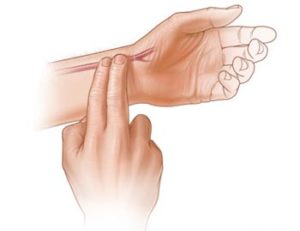
Personally, I recommend placing the pad of the thumb over the blood vessel. It has the largest surface area and therefore the greatest sensitivity. Like this:

Another photograph is here.
Wrap all your fingers around the wrist, from above or below—the photograph shows the grip from below—with the pad of your thumb over the blood vessel. Your hands can rest on your legs if you are sitting on a chair or cross-legged. They can also rest on a table; put something soft underneath to make yourself comfortable.


